Introduction
Sodium hexametaphosphate (SHMP) plays a vital role in various industries, from food processing to water treatment. But is it natural or synthetic? This question is key for consumers and manufacturers alike.
In this article, we’ll explore whether SHMP is a natural product or a synthetic compound, shedding light on its production, uses, and safety considerations.
What is Sodium Hexametaphosphate?
Sodium hexametaphosphate is an inorganic polyphosphate, often used in industrial applications. It is chemically classified as (NaPO₃)₆, meaning it is composed of six phosphate units linked together. SHMP is a white, odorless powder, soluble in water, and commonly available in granular or powdered forms.
Chemical Composition and Structure
SHMP is a polymeric compound with a chain-like structure. Its molecular weight is approximately 611.77 g/mol, and it consists of a series of repeating phosphate groups. The structure gives SHMP its unique properties, such as its ability to chelate metal ions and act as an emulsifier and stabilizer.
Common Uses of Sodium Hexametaphosphate
Sodium hexametaphosphate has a wide range of uses:
● In food processing: It is used as a stabilizer, emulsifier, and texturizer in products like processed meats, dairy products, and beverages.
● In water treatment: SHMP is a dispersant and softening agent, preventing the formation of mineral scale in pipes and boilers.
● In other industries: SHMP is used in ceramics, textiles, and detergents due to its dispersing and binding properties.
Is Sodium Hexametaphosphate Natural?
The term "natural" is often used to describe substances that are derived directly from natural sources like plants, animals, or minerals. In this context, sodium hexametaphosphate (SHMP) does not fit the definition of a natural substance, as it is not sourced directly from nature. Instead, it is produced through a chemical synthesis process.
Chemical Synthesis vs. Natural Occurrence
SHMP is created by chemically synthesizing sodium metaphosphate at high temperatures, where sodium compounds react with phosphates. This process is quite different from extracting minerals or organic compounds directly from natural resources, such as the way other minerals or plants might be harvested.
Can SHMP Be Considered Natural?
While SHMP originates from minerals like sodium phosphate, the extensive chemical processing it undergoes to form the final product makes it synthetic. Although it is derived from natural sources, the complex synthesis process and the final outcome—chemically modified and processed—mean it is not considered "natural" in the traditional sense. The end product is considered man-made rather than naturally occurring.
The Manufacturing Process of SHMP
The production of sodium hexametaphosphate involves several key steps, primarily centered around high-temperature chemical reactions. These processes are essential to transform naturally occurring phosphates into the synthetic product SHMP.
High-Temperature Treatment of Sodium Metaphosphate
SHMP is typically produced by heating sodium metaphosphate, which is derived from sodium phosphate, at temperatures ranging from 600°C to 700°C. The heating process causes the phosphate units to polymerize and form long chains, resulting in the amorphous, glassy substance known as SHMP.
Synthetic Processes Using Phosphates and Sodium Compounds
There are various methods for synthesizing SHMP. Some common methods include:
● Thermal polymerization of monosodium phosphate: This involves heating monosodium phosphate to create sodium acid pyrophosphate, which is then further heated to form SHMP.
● Sodium chloride and phosphoric acid: In some processes, sodium chloride reacts with phosphoric acid to form SHMP through a high-temperature reaction.
Differences Between Natural Mineral Salts and Synthetic SHMP
Unlike naturally occurring mineral salts like calcium phosphate, which can be directly extracted from rocks, SHMP requires chemical synthesis. This distinction underscores the synthetic nature of SHMP, as it involves altering the original raw materials into a more complex chemical structure.
Applications of Sodium Hexametaphosphate
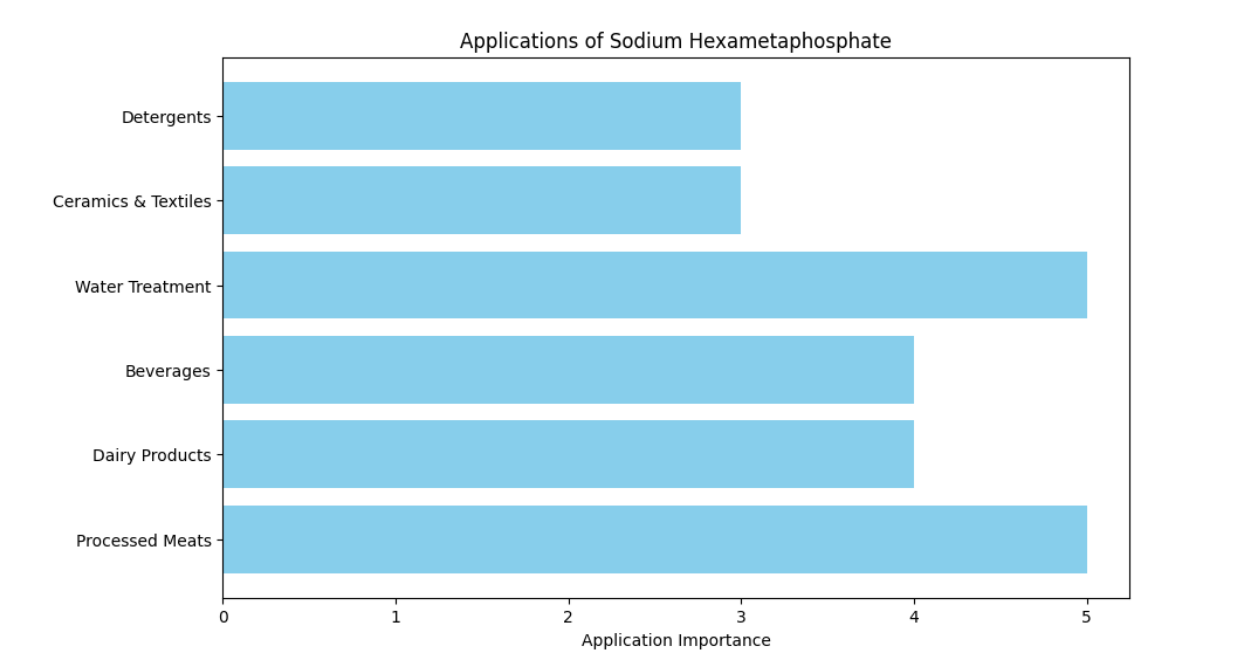
Sodium hexametaphosphate (SHMP) is used across a wide range of industries, showcasing its versatility and the many benefits it offers. Below are some key areas where SHMP plays an essential role:
In Food Processing
SHMP is a vital ingredient in food production, where it is primarily used as a stabilizer, emulsifier, and texturizer:
● Processed Meats: SHMP helps retain moisture in products like sausages, hams, and other processed meats. This prevents the meat from drying out, ensuring a tender and juicy texture.
● Dairy Products: In dairy products such as cheese, SHMP prevents the separation of fat, which improves the texture, consistency, and overall quality of the product.
● Beverages: SHMP enhances the stability of beverages, including fruit juices, carbonated drinks, and protein drinks. It helps improve shelf life by preventing cloudiness and maintaining the product’s clarity.
In Water Treatment
SHMP plays a significant role in water treatment systems due to its ability to sequester metal ions like calcium and magnesium. This property makes SHMP highly effective at preventing scale formation in pipes and boilers. By doing so, it reduces maintenance costs and helps extend the lifespan of equipment, contributing to overall system efficiency.
In Other Industries
● Ceramics and Textiles: In the ceramics industry, SHMP serves as a dispersing agent, ensuring that the clay particles are evenly distributed and maintain a consistent particle size. This helps improve the quality of the ceramic products.
● Detergents: SHMP is used in detergents as a water softener and dispersing agent. It enhances cleaning efficiency by preventing the formation of mineral deposits that could reduce the effectiveness of the detergent.
Industry | Function & Use | Example Products |
Food Processing | Emulsifier, stabilizer, texturizer | Processed meats, dairy, beverages |
Water Treatment | Dispersant, water softener | Industrial water systems, municipal use |
Manufacturing | Sequestrant, dispersing agent, thickener | Ceramics, textiles, detergents |
Safety and Regulation of SHMP
The safety of sodium hexametaphosphate has been rigorously evaluated by regulatory authorities around the world. It is considered safe when used within established guidelines.
Regulatory Bodies and Their Stance
● FDA (U.S.): The U.S. Food and Drug Administration recognizes SHMP as "Generally Recognized as Safe" (GRAS) when used according to good manufacturing practices.
● EFSA (Europe): The European Food Safety Authority has established acceptable daily intake (ADI) levels for SHMP, ensuring its safe use in food products.
Acceptable Daily Intake (ADI) Levels
SHMP has been assigned an ADI by regulatory bodies:
● FDA: The FDA does not set a specific ADI for SHMP but allows its use as a food additive within regulated amounts.
● EFSA: EFSA has established an ADI of 0.025 mg/kg body weight per day for phosphate-based additives, including SHMP.
Consumer Safety and Health Concerns
SHMP is considered safe for human consumption when used within these regulated limits. However, excessive consumption of phosphate additives may pose health risks, particularly for individuals with kidney issues. Therefore, moderation is key when consuming foods containing SHMP.
Regulatory Body | Approval Status | Usage Guidelines |
FDA | GRAS (Generally Recognized As Safe) | Permitted in various food products |
EFSA | Approved as food additive | ADI of 0.025 mg/kg body weight per day |
WHO/JECFA | Approved for use in food | Safe within established ADI limits |
Environmental and Health Considerations
While SHMP is widely used in industrial applications, there are some environmental and health concerns that need to be addressed.
Environmental Impact
SHMP’s use in water treatment, particularly in large-scale systems, can have an environmental impact. Its ability to chelate metal ions raises concerns about the potential contribution to eutrophication (the over-fertilization of water bodies), which can lead to harmful algal blooms and oxygen depletion in aquatic ecosystems.
Health Concerns
Though SHMP is safe for most consumers, there are some health concerns. High levels of phosphate intake have been linked to cardiovascular issues, particularly in individuals with chronic kidney disease. It is important to adhere to regulatory guidelines to minimize health risks.
Environmental Aspect | Impact | Mitigation Strategy |
Water Treatment | Potential for contributing to eutrophication | Use SHMP responsibly in water systems |
Aquatic Life | Low toxicity to aquatic organisms | Proper disposal and use limits |
Industrial Waste | May contribute to contamination if mismanaged | Ensure regulated disposal methods |
Conclusion
In conclusion, sodium hexametaphosphate is a synthetic compound, not naturally occurring. Though derived from natural sources like sodium phosphate, its production involves chemical synthesis. Despite this, SHMP is safe for use across industries like food processing, water treatment, and manufacturing, provided it meets regulatory standards. Aurora Industry Co., Ltd. offers high-quality SHMP, ensuring optimal performance and compliance for various applications. Understanding SHMP's origins and uses helps consumers and manufacturers make informed decisions.
FAQ
Q: What is sodium hexametaphosphate?
A: Sodium hexametaphosphate (SHMP) is a synthetic compound derived from sodium phosphate. It is used as an emulsifier, texturizer, and sequestrant in various industries, including food processing and water treatment.
Q: Is sodium hexametaphosphate natural or synthetic?
A: Sodium hexametaphosphate is synthetic. While it is derived from natural sources like sodium phosphate, its production involves chemical synthesis, making it a man-made product.
Q: What are the uses of sodium hexametaphosphate?
A: Sodium hexametaphosphate is used in food processing, water treatment, and manufacturing. It acts as an emulsifier, stabilizer, and texturizer, enhancing product quality and shelf life.
Q: Is sodium hexametaphosphate safe to use in food?
A: Yes, sodium hexametaphosphate is considered safe when used according to regulatory guidelines. It is approved for use in various food products by authorities like the FDA and EFSA.
Q: Why is sodium hexametaphosphate used in water treatment?
A: Sodium hexametaphosphate is used in water treatment as a dispersant and water softener. It helps prevent scaling by sequestering metal ions like calcium and magnesium.
Q: Can sodium hexametaphosphate be harmful to the environment?
A: Sodium hexametaphosphate can have some environmental impact, especially in water treatment. It is essential to use it responsibly to minimize any potential effects on aquatic life.


